7 STEP HMO STRATEGY
Fill in your name and email for Instant Access


If you’re a landlord in Rushden, Wellingborough, Cambridgeshire or Northampton, you’ll already know that electrical safety is paramount in private rentals. The electricity supply and electrical installations must be checked regularly but there are rules on what, when and who can verify safety.

The Electrical Safety Standards in the Private Sector (England) Regulations 2020 were introduced to improve electrical safety standards in the private rental sector. The good news is these safety rules have remained unchanged since launch, so our guide to electrical safety checks for landlords remains valid.
As well as staying compliant with the latest electrical safety regulations and commissioning an EICR (Electrical Installation Condition Report) every five years, landlords who arrange periodic checks of electrical installations help protect tenants from electrical fire risks.
Our guide will help you comply with your electrical safety obligations.
The legal requirement to ensure electrical safety in private rentals is detailed in The Electrical Safety Standards in the Private Rented Sector (England) Regulations 2020. The Government got tougher on matters of electrical safety as part of the Renters’ Rights Act 2025.
The fine for non-compliance increased from £30,000 to £40,000 on 1st May 2026. Landlords who break the law may also be banned from letting property out in the future. To ensure that doesn’t happen to you or anyone you know, here is our Landlords’ Guide to Electrical Safety.
The Electrical Safety Standards in the Private Rented Sector (England) Regulations 2020 state that landlords must have all electrical installations in their rented properties checked at least every five years. A competent qualified person must carry out any inspections. You can find a suitable, registered electrician by searching NICEIC or NAPIT, or by using the Registered Competent Person Electrical search facility.
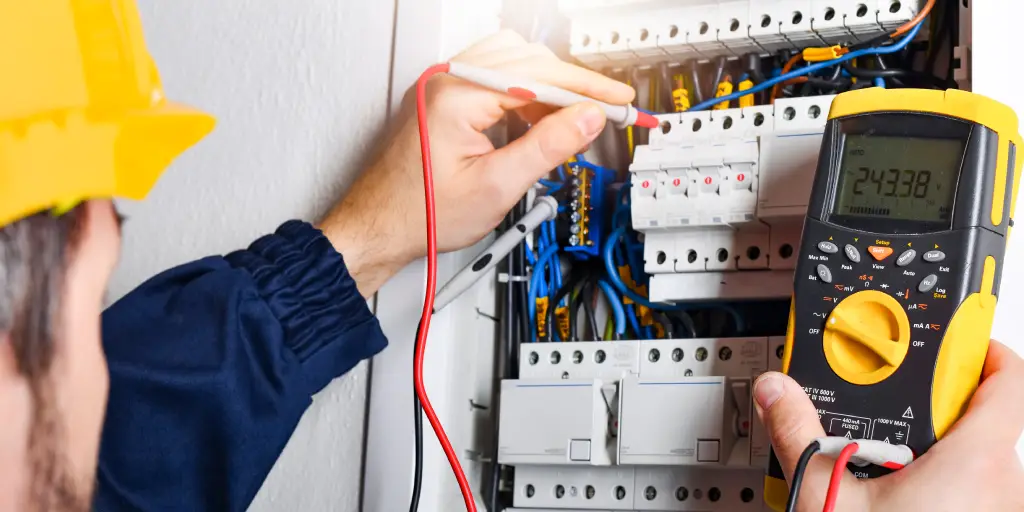
The EICR electrical safety check includes the visual inspection and testing of:
The qualified person will also check modern protective devices, including miniature circuit breakers; residual current devices; residual current breakers with overload; surge protective devices and arc fault detection devices.
The checks will look for any electrical safety issues, such as overloaded power sockets or poor electrical work. EICR testing does not include the testing of portable appliances.
PAT (Portable Appliance Testing) is not a legal requirement for landlords but it is good practice to get portable appliances tested at the same time as EICR testing. PAT tests check appliances such as washing machines, fridges and microwaves for any electrical safety issues.
To comply with the regulations, all landlords who rent out private accommodation must meet the following requirements:
The Regulations were extended to cover England’s social housing sector in 2025. As such, regulations now apply to any property where a tenant – private or social – pays rent and has the right to occupy the property as their main residence (including periodic tenancies).
The only exceptions to complying with these Electrical Safety Regulations are student halls of residence, hostels, refuges, care homes and accommodation relating to healthcare provisions. There are different regulations for these types of properties.
The other exceptions to these Regulations are tenants on a lease of 7 years or more and lodgers living in the same property as the landlord.
New build properties should have an EIC (Electrical Installation Certificate) issued when the electrical installation is completed. This will usually be valid for five years from the date of issue. Landlords will be required to arrange an EICR when the EIC runs out.
Similarly, if your buy-to-let property has a full rewiring, an EIC valid for five years will be provided. Once the EIC is no longer valid, an EICR is required.
The Electrical Safety Standards in the Private Rented Sector (England) Regulations 2020 also apply to houses in multiple occupation (HMOs).
There is a particular rule for HMOs that house 5 or more tenants. The Housing Act 2004 includes a mandatory condition that a HMO licence can only be issued on the provision that every electrical installation in the HMO is in proper working order and safe for continued use.
Once an EICR has been produced and any remedial work completed, landlords should be issued with a safety certificate confirming the supply and electrical installations have passed all checks.
Under regulations, a copy of the safety certificate and a copy of the report must be given to each tenant in the property within 28 days of the inspection, as well as made available to new and prospective tenants upon request.
The landlord’s electrical installation report record should also state when the next inspection is due. Unlike gas checks, which must be carried out with each new tenancy, the electrical safety certificate for landlords is valid for five years.
In other words, an electrical check is not necessary every time there is a change in tenancy. Instead, the landlord can show new tenants the last, most up-to-date electrical safety report. A landlord, however, must not let the certificate expire.
Electrical safety tests for landlords are known as an Electrical Installation Condition Report (EICR). This is what you should ask for when you speak to a qualified person, explaining you are a landlord.
Items that will be tested include lighting, switches, sockets, consumer units and protective bonding.
An EICR highlights whether or not an electrical installation is safe by grading it ‘satisfactory’ or ‘unsatisfactory’. It also outlines what needs to be done to improve the installation, if necessary.
A Satisfactory Code is:
In the case of a C1, C2 or FI code, the landlord must make the necessary improvements.
This isn’t always the case with a C3, since it may mean the item just doesn’t comply with current regulations (although it did when it was installed). It’s possible the property would be given a ‘Satisfactory’ grading for the EICR.
An unsatisfactory grading will need prompt landlord action.
Any remedial work or further investigations must legally be made within 28 days of the original test. A qualified person may suggest urgent repairs is a shorter timeframe.
The landlord must prove the remedial work has been completed by providing the tenant with a satisfactory EICR, an Electrical Installation Certificate (EIC), a Minor Electrical Installation Works Certificate (MEIWC) or other appropriate electrical certification.

Non-compliance and regulatory breaches can result in a fine of up to £40,0000. The local authority can also force the landlord to undertake remedial work and recover the costs from the landlord.
If you contact your tenant and they have not responded or have refused access, it is important that you keep records of your communications. Landlords need to provide at least 24 hours’ written notice to tenants to request consent to access the property for the inspection.
The records of communication will help evidence that you have taken reasonable steps to arrange access to conduct electrical safety tests for landlords. If the tenant does not respond to the initial communication, you should send a further communication to remind them that not providing access is a breach of contract and legal action could follow.
Local authorities routinely look for rented properties that don’t meet their ‘fit to live in’ criteria. A rented property that fails an electrical installation check will undoubtedly fall into this category. Local authorities have upgraded powers to issue fines of up to £40,000 for regulation breaches and safety non-compliance.
As it is the landlord’s responsibility for electrical testing, all unsatisfactory checks must be reported to the local authority, together with confirmation of the repairs. Failure to do so can result in enforcement action on the part of the council, which could affect your ability to rent out properties in the future.
A qualified person is deemed competent under the latest version of the wiring regulations (BS 7671), with at least two years’ experience in such checks.
They must also have at least £2 million of public liability insurance and up to £250,000 of professional indemnity insurance. They should also hold a qualification covering the periodic inspection, testing and certification of electrical installations.

Landlord electrical safety certificates for the private rental sector are normally invalid unless they have been produced by a competent, qualified person. Landlords can use NICEIC, NAPIT or the Registered Competent Person Electrical search facility to check whether an electrician they want to use is registered, verify a certificate as legitimate, and check a trade’s insurance and qualifications.
Failure to get an electrical safety report can result in your local council imposing a fine of up to £40,000. If a remedial notice is issued, the checks and any remedial work must be carried out within 28 days. If this is ignored, the council can organise for the work to be carried out and bill the landlord for the costs.
A landlord can choose to provide portable electrical appliances to tenants. These can include white goods, such as washing machines, fridges, freezers, dishwashers and tumble dryers, as well as smaller appliances, such as heaters, microwaves, kettles and toasters.
Landlords should supply operation manuals for all electrical appliances present in the property to encourage safe use.
An EICR won’t test portable electrical appliances but their safety can be verified by PAT testing. Although there is no legal requirement for landlords in England to PAT test portable electrical appliances, it is best practice. Remember, landlords have a moral responsibility to make sure tenants don’t get hurt or injured by faulty electrical appliances.
Landlords, however, are not responsible for PAT testing on electrical appliances that the tenant has brought to the property. For the safety of everyone and everything, a landlord could offer to PAT test a tenant’s appliances at the same time as the testing of any supplied electrical goods.
If you still have questions about electrical safety checks for landlords, contact the Progressive Lets team for advice. We provide property management and lettings services in areas around Peterborough, including Cambridgeshire, Northampton, Rushden and Wellingborough.
Use our 63-point checklist to verify
that your rental property is compliant
Contact us, and we will be more than happy to help you.
"*" indicates required fields


Last month it was revealed that Coventry City Council was stepping up the hunt for unlicensed HMOs, following complaints from residents a...

Why use a sample landlord inventory? Quite simply, completing a robust inventory can avoid a dispute – and provide vital evidence if you ...

As autumn temperatures drop, a new terror lurks for landlords – that of damp and mould. Several factors can cause it, but









7 STEP HMO STRATEGY
If you are looking to invest in an HMO or are an existing HMO landlord wanting to improve your yield and occupancy levels, then our 7 Step HMO Strategy is for you.
Get your FREE COPY of our '7 Step HMO Strategy’ TODAY!