FREE Landlord
Compliance Checklist
Use our 63-point checklist to verify
that your rental property is compliant

Wisbech offers many unique benefits to property owners who are looking for more affordable properties compared to wider Cambridge prices. With beautiful Georgian properties, ample green spaces and a wide choice of property types, Wisbech is an ideal location for investors, families and professionals.
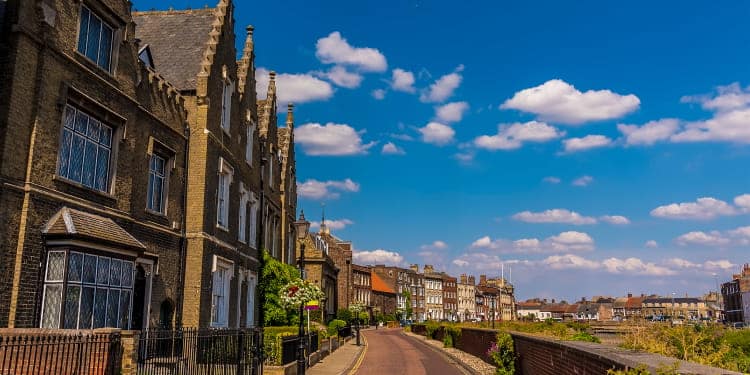
From listed properties running along the River Nene to modern housing estates, there is a great choice of property options in the local Wisbech market.
Average prices in Wisbech sit well below the Cambridgeshire average, which attracts buyers priced out of Peterborough and the wider county, as well as landlords seeking yields that have become difficult to find further south.
What makes Wisbech distinctive is the contrast between its historic core and its surrounding residential streets. The Georgian centre is well-preserved, which is rare in other areas of the county where there have been faster paced development. This provides a quieter and more picturesque environment but there are drawbacks if you are looking for modern local amenities and fast transport connections.
For tenants and landlords alike, the town offers a range of property to suit a range of budgets.
Wisbech’s has a wide property mix with more affordable options across all property types compared to other parts of Cambridgeshire.
| Property type | Typical period | Typical tenure | Approximate price range |
|---|---|---|---|
| Georgian townhouse / terrace | 1750–1840 | Freehold | £200,000–£450,000+ |
| Victorian terrace | 1860–1900 | Freehold | £120,000–£185,000 |
| Inter-war semi-detached | 1920s–1930s | Freehold | £170,000–£220,000 |
| Post-war detached | 1950s–1980s | Freehold | £220,000–£320,000 |
| Purpose-built flat | 1970s–2000s | Leasehold | £80,000–£110,000 |
| New build (current schemes) | 2020s | Freehold / leasehold | varies |
Price ranges derived from Land Registry and portal research data, 2025–2026. Individual properties vary significantly.
The most architecturally significant stock sits along North Brink and South Brink, following the curve of the River Nene. These are substantial three- and four-storey townhouses, typically built between 1750 and 1830, with formal frontages, sash windows, and generous room sizes.
Peckover House, built in 1722 and now held by the National Trust, anchors the northern side. The Crescent, constructed in the early nineteenth century, is a curved terrace of Georgian houses encircling a central space on the site of the old Norman castle moat. These properties come to market rarely and command premiums that reflect their rare availability.
The majority of Wisbech’s residential streets are Victorian terraced housing, built as the town expanded through the latter half of the nineteenth century. These are typically two-up two-down or three-bedroom configurations, with brick construction, slate or plain tile roofs, and small rear yards. They form the bulk of the rental market and represent the most accessible entry point for buyers, with average sold prices over the last 12 months for terraced properties running at around £139,000 according to Rightmove.
The outer residential areas carry a substantial number of inter-war semis and post-war detached houses, with semi-detached properties averaging £191,624 and detached homes £266,058 for sale prices over the last 12 months. Wisbech has proportionally more semi-detached homes than the wider PE postcode area, reflecting the suburban expansion of the mid-twentieth century. Detached properties on the town’s edges tend to sit on larger plots with proper rear gardens, which makes them attractive to families.
Purpose-built flats are less common in Wisbech than in comparable towns. Around 10% of people under the Fenland district council live in flats, while the percentage in Cambridge is around 35%. Average flat prices range from around £60,000 to £145,000, making them accessible for first-time buyers and investors, though stock is limited and condition varies considerably.
Wisbech sits within one of Fenland’s ten designated conservation areas, and it is the most architecturally significant of them. Fenland District Council recognises the area as having special architectural and historic interest, with planning controls applied accordingly.
Buyers purchasing within or immediately adjacent to the conservation area should take advice from Fenland District Council’s planning and conservation team before committing to any alterations as restrictions are enforced.
The Georgian stock on the Brinks and in The Crescent is unusually well preserved in its external form, partly because listed building controls have limited harmful alterations. Internally, however, some properties were subdivided into flats during the mid-twentieth century, and buyers should verify the current configuration and any consent history carefully.
The Victorian terraces in Wisbech vary considerably in condition. Some streets have seen sympathetic renovation; others carry decades of deferred maintenance. The prevalence of uPVC replacement windows is high, which can complicate planning applications if a property is brought into a conservation area boundary.
Inter-war semis in Wisbech are generally well suited to families and hold their value more steadily than the Victorian terraces, though they are less distinctive architecturally.
Wisbech is seeing meaningful new housing growth on its edges. In May 2025, planning permission was granted for 300 new homes on land off Stow Lane, forming part of a wider urban extension of up to 1,450 homes allocated for the town.
A separate scheme proposes 308 eco-friendly homes and a 60-bed care home to the east of the town, with full and outline planning applications submitted.
Fenland District Council approved both schemes despite criticism from planning committee members regarding the absence of affordable housing provision and limited financial contributions toward local infrastructure. More than 1,000 new homes received planning permission across Fenland in 2025 as a whole, with Wisbech accounting for a significant share.
The new build schemes are predominantly family houses on greenfield land, which will add to the detached and semi-detached stock on the edge of the town. They do little to address the shortage of smaller starter homes and bungalows that the council has identified as a gap in the local housing mix. For buyers considering new builds, it is worth checking which schemes have reserved affordable units and what the s106 contributions cover before committing.
Outside space in Wisbech varies sharply by property type and location.
Off-street parking is more available in Wisbech than in comparable historic towns, particularly on streets built after the 1930s, where driveways are standard. In the conservation area, however, dropped kerbs and hardstanding to front gardens require consent, and approval is not guaranteed where it would harm the character of the streetscape.
Wisbech’s period stock, particularly the Georgian and Victorian properties that make up much of the town’s character, brings specific survey considerations that buyers should understand before making an offer.
A full RICS Level 3 Building Survey is the appropriate instruction for any pre-1940s property in Wisbech – a HomeBuyer Report is unlikely to capture the level of detail these buildings require (RICS guidance).
Victorian terraced houses make up the largest share of Wisbech’s residential stock, followed by inter-war semi-detached houses and post-war detached properties. The town’s Georgian townhouses are concentrated in the conservation area and come to market infrequently. Purpose-built flats are less common here than in comparable towns.
Yes. Wisbech town centre is a designated conservation area recognised by Fenland District Council for its special architectural and historic interest, centred on the Georgian streetscapes of North Brink and South Brink, The Crescent, and the market area. Within the conservation area, permitted development rights are restricted and external alterations require consent. Several buildings, including Peckover House, are Grade I listed with Historic England.
The majority of houses in Wisbech are freehold. Purpose-built flats are typically leasehold, and buyers of any flat should check the lease length, service charge history, and ground rent terms before proceeding. Some Georgian townhouses that were subdivided into flats may have complex title arrangements worth investigating with a solicitor.
The main considerations are damp in solid wall construction, chimney condition, the age and condition of electrical systems, flat roof extensions, drainage, and subsidence risk given the Fenland soil conditions. For listed properties, check whether any alterations were carried out without consent, as liability transfers with ownership. Commission a RICS Level 3 Building Survey rather than a basic valuation or HomeBuyer Report.
Yes. Planning permission was granted in 2025 for 300 homes off Stow Lane as part of a wider urban extension of up to 1,450 homes, and a further 308-home scheme to the east of the town has also been submitted. These are predominantly family houses on greenfield sites at the town’s edges. Affordable housing provision on both schemes has been limited, which prospective buyers should factor into their assessment of any new build purchase in these locations.
Whether you’re a landlord assessing Wisbech’s rental potential, a tenant weighing up what different property types offer day to day, or you are looking to buy a new property to live in, the town has many options.
Progressive Lets works across the Peterborough and Fenland area and can help match your requirements to the right property and street. Get in touch to talk through what’s available.
Use our 63-point checklist to verify
that your rental property is compliant
Contact us, and we will be more than happy to help you.
"*" indicates required fields


Think Rushden is just another straightforward commuter-town purchase? Think again. Beneath its unassuming exterior lies a surprisingly la...

Priced out of Northampton but not ready to compromise on space? Rushden keeps coming up - and for good reason. With property prices well ...
In Rushden, two streets that look almost identical from the outside can tell very different stories for landlords and tenants alike. The ...