FREE Landlord
Compliance Checklist
Use our 63-point checklist to verify
that your rental property is compliant

If you’re considering renting a home in Corby – or buying one to let – it’s worth considering the types of homes available in the area.
One of the unique aspects of the Corby property market is how much the housing stock tells you about the town’s history.
Steel brought workers here in large numbers from the 1930s onwards, and the housing that was built to accommodate them. This included rows of solid terraces and council-built semis, which still makes up a substantial portion of what you’ll find on the market today. Beneath that industrial-era layer sits a much older village core, and above it, one of the largest ongoing housing expansion programmes anywhere in England.
That range means Corby offers a huge range of property choice in a town where a 1930s former council terrace, a 1960s semi, and a brand-new detached home on a major development site can all be found within a couple of miles of each other.

The town is growing fast. With more than 10,000 homes currently being built or planned across the borough, and North Northamptonshire Council actively pursuing New Town status to accelerate delivery further, the property mix here is changing at a pace that few towns can match.
For landlords assessing buy-to-let stock, or tenants weighing up what the rental market looks like, understanding that mix is where to start.
| Property type | Typical period | Typical tenure |
|---|---|---|
| Terraced houses | 1930s–1960s | Freehold |
| Semi-detached houses | 1950s–1980s | Freehold |
| Detached houses | 1980s–present | Freehold |
| Purpose-built flats | 2000s–present | Leasehold |
| New build (all types) | 2010s–present | Freehold/Leasehold |
The most common property type in Corby is the mid-twentieth-century terrace. Much of this stock was built during the rapid expansion of the steelworks from the 1930s through to the 1960s, when the town’s population grew dramatically and housing was needed quickly. These properties are typically two-storey, brick-built, with three bedrooms, a rear garden, and a straightforward floor plan. They are solid rather than architecturally distinctive, but they represent good value for money and are widely sought after by both owner-occupiers and landlords.
Semi-detached housing from the same era, and from the post-war period into the 1980s, sits alongside the terraces across much of the older residential neighbourhoods. These are generally slightly larger, with driveways more common, and they form the backbone of the family rental market in the town.
Detached housing in Corby becomes more prevalent in the developments built from the 1980s onwards, particularly in areas to the north and east of the town centre. These properties tend to offer larger footprints, garages, and gardens, and they appeal to buyers and tenants looking for more space without moving to a village location.
Purpose-built flat development in Corby has accelerated since the early 2000s, with town centre regeneration bringing leasehold apartments into a market that was previously dominated by houses. The recently approved scheme on Alexandra Road consisting of 150 mainly one- and two-bed flats on the former Co-op site is a good example of growth in town centre supply.
Converted flats are less common here than in older towns with larger Victorian villa stock, but they do exist, typically in converted commercial buildings or older large houses near the town centre.
New build is the fastest-growing segment of Corby’s housing market, and it is likely to remain so for the foreseeable future. With major developments under way or in planning across the borough, new homes in Corby range from starter homes and two-bed terraces to four- and five-bed detached properties on larger estates. These developments are generally freehold for houses, with leasehold applying to flats.
Corby’s conservation designation picture reflects its dual identity as a small historic village that was absorbed into a rapidly industrialised new town.
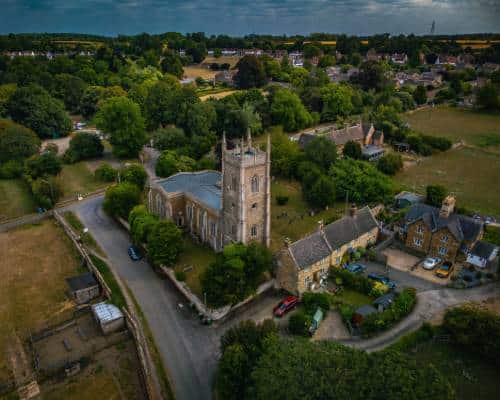
The original village of Corby, the settlement that existed before the steelworks arrived, retains a conservation area designation covering the old village core around Church Street and the parish church of St John the Baptist. This area contains the oldest building fabric in the town and is subject to the standard permitted development restrictions that apply within conservation areas. For example, alterations to external appearance, including window replacements and extensions visible from a public highway, require prior approval or full planning consent rather than being permitted as of right.
St John the Baptist Church itself is a listed building, reflecting its significance as the historic focal point of the original settlement. Buyers considering property within or immediately adjacent to the old village conservation area should factor in the additional consent requirements and the restrictions on materials such as like-for-like repairs being expected, and the use of inappropriate modern materials on external surfaces is unlikely to receive approval.
Away from the old village, Corby’s twentieth-century development was not subject to the kind of planned conservation that characterises older market towns, and the vast majority of the town’s housing stock sits outside any designation. This means permitted development rights apply broadly across most of the residential areas, giving owners more flexibility for extensions, loft conversions, and alterations, which is a relevant consideration for landlords assessing improvement potential.
For the most current designation boundaries and appraisals, the North Northamptonshire Council planning portal is the definitive reference, and Historic England’s listed buildings records should be consulted for any specific property.
These are the defining property type of the older residential Corby neighbourhoods. Characteristic features include:
The internal layouts are functional rather than generous: a front room, rear living room or kitchen-diner, and two or three bedrooms is the standard arrangement. Original features are variable, as many properties have been updated over the decades, and original joinery, fireplaces, and flooring survive in some but have been removed in others. Buyers looking for preserved period detail will need to look carefully, as the level of retention varies considerably from street to street.
Housing built in the post-war decades tends toward larger footprints, with more emphasis on indoor space and less on traditional external detailing. Features typical of this era in Corby include:
This stock is generally more adaptable for modern use, with layouts that suit open-plan reconfigurations more easily than the smaller pre-war terraces.
Contemporary new build in Corby broadly follows national developer conventions of brick or brick-and-render exteriors, energy-efficient glazing, open-plan ground-floor layouts, and en-suite bathrooms on principal bedrooms. Build quality varies by developer and scheme, and buyers and landlords should assess snagging issues carefully on recently completed properties.
Corby is one of the most active development locations in the East Midlands. The scale of planned growth is significant with more than 10,000 homes are currently being built or planned across the borough, according to North Northamptonshire Council, and the council has formally requested that the government consider adding Corby to its New Towns programme to accelerate delivery further. If that designation is secured, it would unlock targeted government support for housing infrastructure at a scale that would materially change the town’s property mix over the coming decade.
In the town centre, new developments are also emerging. For example, the Alexandra Road scheme includes 150 one- and two-bed flats on the former Co-op site. This type of scheme is particularly relevant to landlords as these compact, centrally located flats in a growing town with an expanding workforce tend to perform well in the rental market.
Commercial investment is also reshaping the local economy in ways that affect housing demand. Nike’s decision to establish its UK base in Corby, alongside significant logistics and warehousing investment, is drawing workers to the town and sustaining rental demand across multiple price points.
The majority of Corby’s terraced and semi-detached housing stock comes with rear gardens, and this is one of the practical advantages the town offers over denser urban markets. Rear gardens on 1930s to 1950s terraces are typically of reasonable depth with sufficient space for outdoor seating and storage, though plot widths are modest. Many front gardens across the older streets have been partially or fully paved for off-street parking, which has reduced the greenery on some terraces but improved practicality.
Semi-detached properties from the post-war period generally offer slightly larger plots, with side returns common and some properties benefiting from detached garages or substantial driveways. Detached houses on 1980s and later developments tend to have the most usable garden space, with side and rear gardens that are more generously proportioned.
Purpose-built flat developments typically offer communal outdoor areas rather than private gardens, and this is a relevant consideration for tenants assessing lifestyle fit. Town centre flat schemes, including the newer apartment developments, will generally have limited or no private outdoor space.
Off-street parking is reasonably prevalent across the older residential areas, either through converted front gardens or driveways on later builds. On-street parking is the norm in the densest terrace streets, where plot widths do not allow for front-garden conversion without losing the garden entirely.
Corby’s expanding population, major employment investment, and large-scale housing pipeline make it one of the more active rental markets in the East Midlands right now. Whether you’re a tenant looking for your next home or a landlord assessing the town’s investment potential, Progressive Lets can help. Take a look at our landlord services to see how we work with property investors in the area, or contact us to talk through what’s available.
The majority of Corby’s housing stock consists of mid-twentieth-century terraced and semi-detached houses, built during and after the steelworks expansion. New build properties are a growing part of the market, with more than 10,000 homes currently being built or planned across the borough.
Yes. The original village core around Church Street is subject to a conservation area designation, covering the oldest building fabric in the town. Most of Corby’s wider residential areas, built as part of the post-war expansion, sit outside any designation.
Houses in Corby are predominantly freehold. Leasehold applies mainly to purpose-built flats and some new build apartment schemes. Buyers should check tenure carefully on new build properties and review lease length and service charge terms before proceeding.
Corby is one of the fastest-growing towns in England, with more than 10,000 homes currently being built or planned in the borough. North Northamptonshire Council has formally applied for Corby to be considered for New Town status, which would unlock further government support for housing and infrastructure delivery.
Use our 63-point checklist to verify
that your rental property is compliant
Contact us, and we will be more than happy to help you.
"*" indicates required fields

Two streets in Corby can look identical on a map yet deliver different results for landlords and tenants. With over 10,000 homes in the ...
Corby is a fast-growing North Northamptonshire town that's becoming more and more of an attractive choice for investors, landlords and te...
Last month it was revealed that Coventry City Council was stepping up the hunt for unlicensed HMOs, following complaints from residents a...